

Passing the Baton
Five years on, what Virgil Abloh’s final film reveals about music and legacy.

21st January 2026 marks 5 years since Louis Vuitton released its Fall-Winter 2021 men’s collection. The final Virgil Abloh collection that he oversaw in its entirety was presented as a short film.
It is also his magnum opus.

Sadly, Virgil passed away on 28th November 2021, aged just 41, having battled a rare form of cancer that he had known about for some time, but kept private from everybody but his closest circle.
One of these was British DJ Benji B, who collaborated with Abloh for years to soundtrack runway shows, parties, and as music director on Louis Vuitton short films including Fall-Winter 2021.
Peculiar Contrast, Perfect Light
If you haven’t seen this before, go full screen and lock in for 15 minutes of sensory bliss. If you have seen it before, I trust you’ll do the same.
The opening spoken word poem by Saul Williams is half-cryptic and half-bold-declaration. Adaptated from James Baldwin’s “Stranger in the Village” essay and arriving in the wake of the Black Lives Matter protests, the statement reads as a black man existing within and moving through a hostile white world. But, he says, “I am no stranger anymore…. the snow will melt, the ice will thaw, and make it up to me.”
After a brief interlude of slo-mo ice skating, which feels like it represents people coming into form, we are again dropped into a cold space. This time, within a built environment - Abloh drawing on his training as an architect.
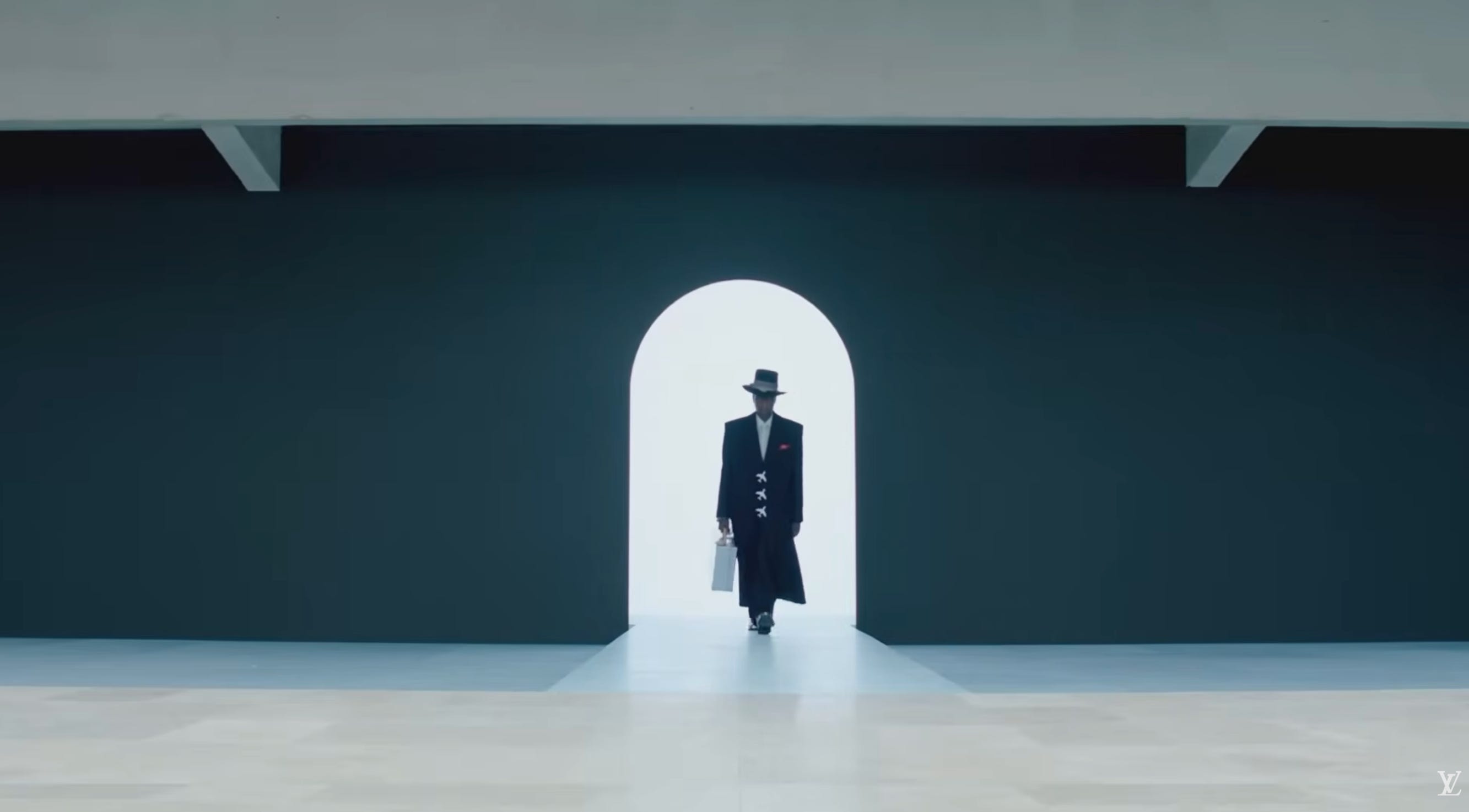
Williams carries a small suitcase and wears a trench adorned with aeroplane button fasteners. Wistful music is piped through a tannoy system. It feels like we’re in an airport - although it doesn’t look like it, yet.
The line “make it up to me” is repeated as mantra. Melding with slow stuttering breakbeats and eerie violin samples used across hip-hop tracks like Busta Rhymes - “Gimme Some Mo”.
As other characters enter, the scene starts to feel quotidian but alive. People carrying coffee cups, newspapers. Some things are off though: a man in a suit lies slumped against a green marble wall, lifted from Mies van der Rohe’s 1929 Barcelona Pavilion; some characters stand motionless; others look over their shoulder as if watched.
“Take down the walls. Deconstruct the narrative. Unravel the mystery. Make space for me. And all the spaces in-between.”
The vocal begins to warp and sound darker. Williams breathlessly lists names of cultural deities viewers may recognise, “Whitman, Ginsberg” and other beat poets get a mention. When he says names like “Holiday, Davis, Coltrane,” with conviction, passers-by stop and stare like he is a crazed vagrant.
A jazzy interpretive dance scene is followed by a camera that slips between physical monuments. Sometimes literally. Spoken words tread a line between theft and rightful ownership.
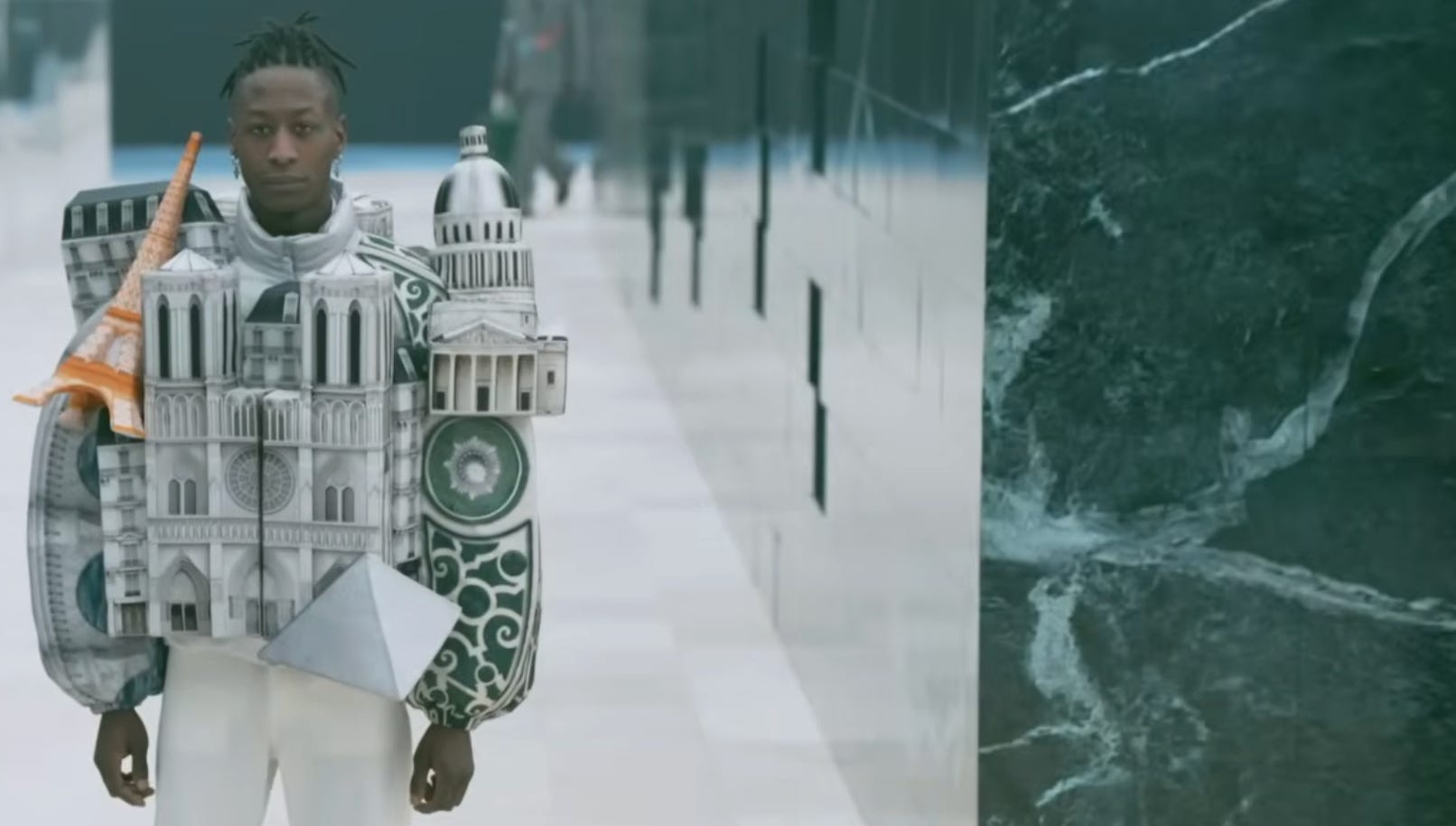
At 08:30 a man is handed a suitcase, which initiates our screen filling with bodies walking at pace, turning at right angles, carrying and exchanging bags. The density increases, until they disperse and we’re left looking at one man through a CCTV camera.
Yasiin Bey AKA Mos Def, dressed in a purple and green trench, raps over the top of ESG’s “UFO” - the perfect soundtrack with its unnerving and paranoid sound. These themes feel particularly acute to Abloh, who was articulating global travel to a world caught in a liminal space - heavily surveilled and with movement restricted. Mad camera angles fly up and zoom land on Yasiin and other characters. Throughout, symbols like butterflies are threaded into the clothes and through the narrative, as an ode to freedom.
Music as Structure
Watching this film made me rethink music’s role in fashion.
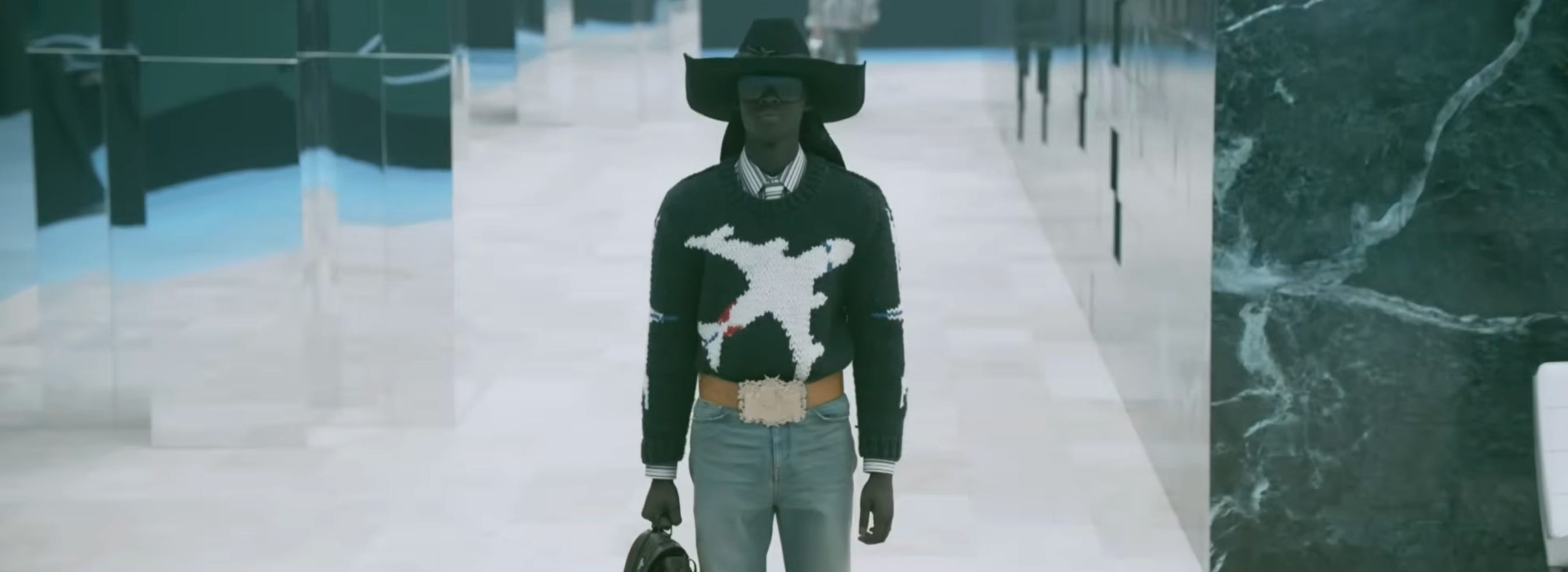
When the film arrived I was conducting strategy work for another luxury fashion brand. This involved a lot of time spent researching other brands, to be abreast of their marketing and positioning - watching films and runway shows. I came to learn a lot, however, I don’t follow luxury brands as a devotee. I mean, I would have liked to spend £1,000 on this beautiful jumper from the collection.
Over that period I watched a short film from Celine set in a French stately home. The tone was darkly gothic, medieval in fact - which several years later emerged - somewhat hilariously - as a Pinterest endorsed aesthetic: “Castlecore”. There is, of course, far more to this than aesthetics: power, hierarchy, tech overlords and the construction of a new caste system.
For all their perceived frivolity, there is some exceptional work happening at these houses that does initiate or capture zeitgeist thinking. The Celine film incorporated music by The Loom. A side-project of a favourite band of mine: These New Puritans [one of whom is a brilliant drummer and happens to be a model].
A select few still hold the reins in this world.
Music Director, Michel Gaubert, who has been responsible for many runway soundtracks for Chanel, Dior, Junya Watanabe and Loewe, released his memoir “Remixed” last year which chronicles three decades in the industry. Speaking with Another Magazine, he said “Early on, I realised that I liked the way musicians expressed themselves and what they wore. To me, fashion and music are ... inextricable.”.
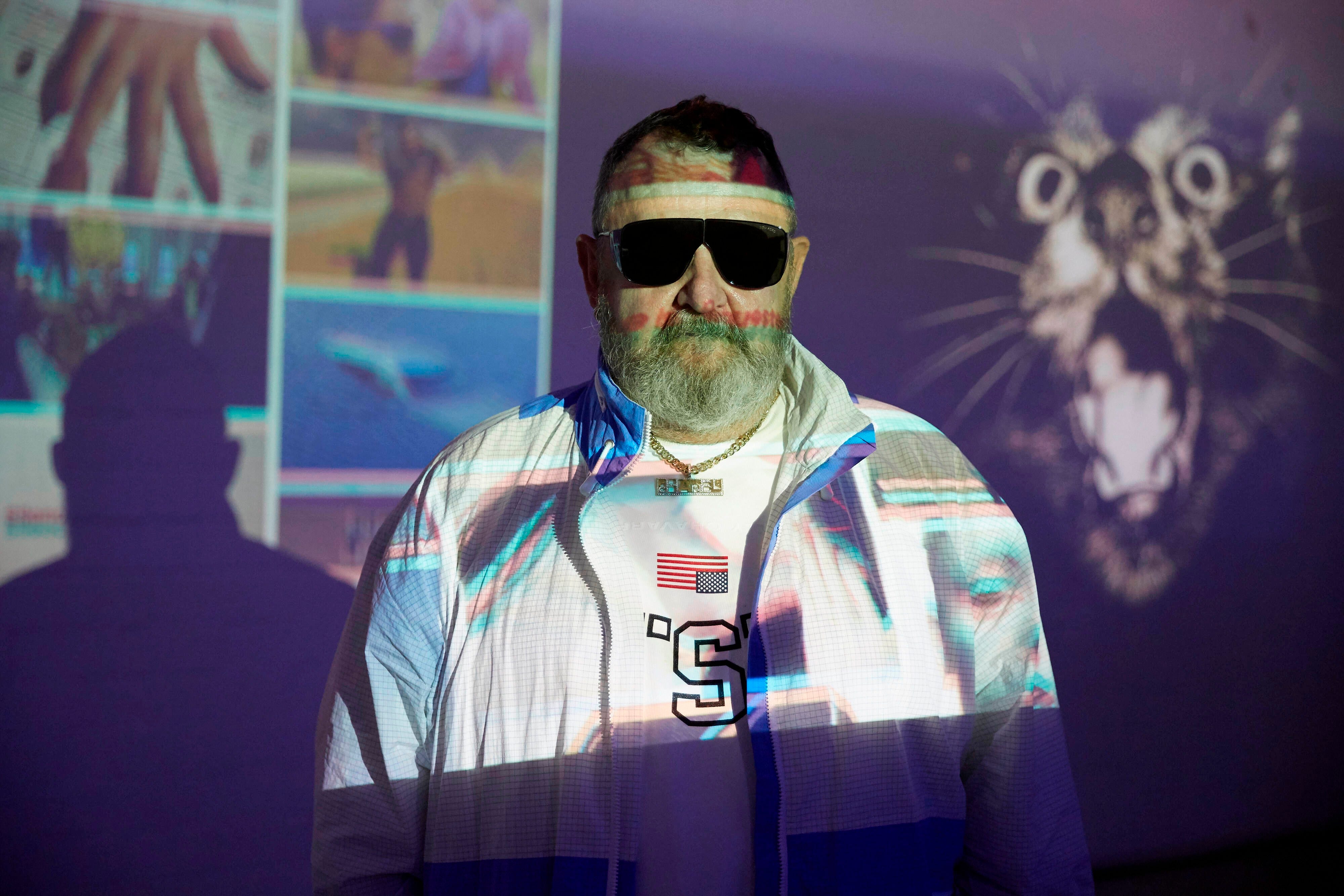
One of my favourite music inclusions of Gaubert and his partner Ryan Aguilar [also a music supervisor] was Not Waving on the Fendi AW 2021 runway. Although Not Waving was working with music labels like DeeWee [Soulwax - who, related: just collab’d with Dover Street Market], it’s interesting that an artist with a relatively low profile was identified to soundtrack a runway show.
An artist I like who moves in this world is Ioanna Gika. Based in LA, with Greek roots, she first came to my attention as part of IO Echo alongside Leopold Ross [brother of Atticus who is in Nine Inch Nails]. Ioanna has recently played live shows with Air and Grizzly Bear, and has collaborated with the luxury fashion houses Celine and Dior, composing specifically for the shows.
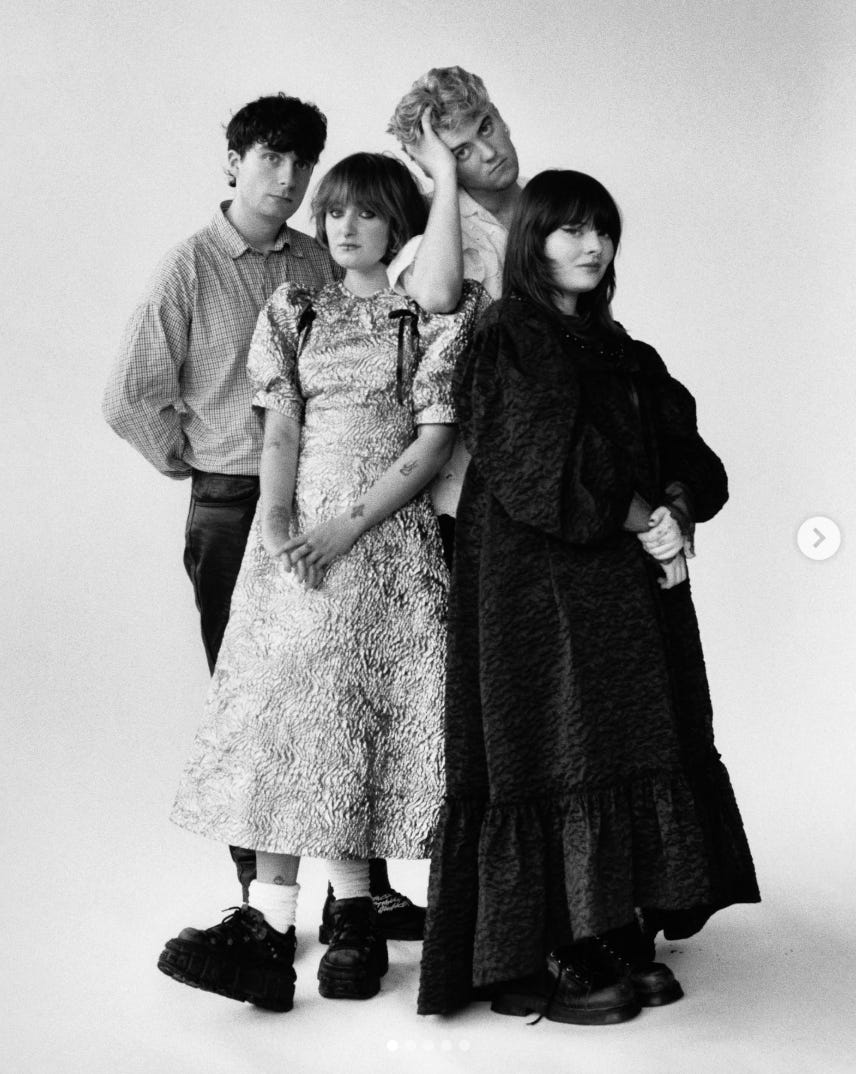
Another carefully chosen example I remember seeing is NewDad, who soundtracked a Celine video on socials very early into their career. As a fan I was chuffed for them. After a run of excellent EPs and two full lengths, they’ve gone on to establish themselves with Glastonbury Festival appearances, two tours in Asia, a collab with Daniel Avery and an endorsement from Robert Smith of The Cure! I imagine this sync meant a great deal to them at the time.
Hearing and seeing credible artists involved with huge conglomerate luxury houses could be disarming, however, I’ve tended to see it as positive for their career. There are so few opportunities available to musicians that they can leverage for growth and capital - luxury fashion soundtracks are essentially sync opportunities - albeit with a lot of prestige.
In the world of influencer/creator marketing, there has been a slow move toward ambassadorial roles as opposed to “one-and-done” campaigns. There are multiple benefits to this approach [many of which come down to measurability and time spent on admin] but it also tracks back to building credibility and loyalty over time instead of reaching for and trying to manufacture attention.
Legacy
Fashion and luxury houses can offer artists stability; they themselves operate in a grey area. Heritage confers credibility by default, but it does not guarantee relevance - and they need to grow. Fashion and music operate on a similar cultural plane, in the sense that both are sensitive to exposure, but also require it.
Music is inextricably linked to fashion.
TikTok and Spotify virality do not last. Ask Benson Boone in 5 years. It doesn’t equate to loyal fans. It doesn’t automatically result in an appearance on Jimmy Kimmel or Jools Holland, or a festival appearance. This is because it thrives off shallow engagement via a one dimensional format. Algorithms may surface music, but it can have limited cultural impact when it is listened to passively and without editorial.
More people are moving away from social and Spotify, and toward platforms like Cantilever and Nina for curated takes. The Cantilever founder describes the platform as “a magazine you can listen to” - with plenty of room given over to editorial coverage.
Fashion and Luxury music directors can play a similar role in this new world, however, entrenched systems and firmly established curators could underserve new artists and those from under-represented groups. Personally, I think some things should be gate-kept. Tastemakers can turn people onto overlooked work, and offer a counterbalance to algorithms with just enough friction and required knowledge.
Fashion and luxury houses are facing challenges - even in China there is less spending power and less aspirational spending. In the face of economic challenges, doubling-down on cultural power through music is a clear strategy. If a vacuum is created, other brands have the opportunity to step in - albeit without the same capital to support artists.
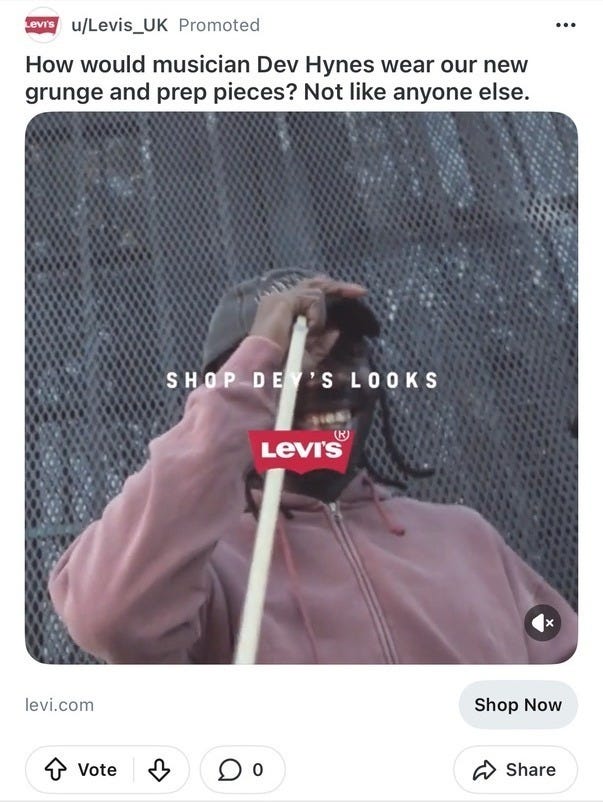
For decades, brands such as Dr Marten’s, Fred Perry and Levis have played an important role within the music ecosystem. Now, it’s less about being seen to provide artists with exposure, and more about a brand showing itself to be genuinely supportive. It works best when brands go slower but deeper. Dev Hynes [Blood Orange] is working with Levis on a store edit at the moment.
Fashion brands can look beyond their own category for inspiration. In film, A24 recently launched a record label, and kicked off a YouTube live series featuring the brilliant Model/Actriz. In the same vein, there are opportunities for challenger brands across a range of categories to step in and support musicians. It’s not right for every brand, but it’s a great role that’s in demand.
This could take the shape on in-store performances, dressing artists for performances and PR or in brand-owned comms - like a Desert Island Discs feature, a visual exploration into an album they made, a branded playlist on cassette. At the crux, brands can utilise music to communicate emotion, build trust with people.
I regularly think about the phrase “Tourist vs Purist” stamped across items in the Louis Vuitton film. It captures Abloh’s meditation on access and cultural permission, and feels prescient now, as algorithms shape how much of culture circulates. It’s a useful compass in conversations about gatekeeping.
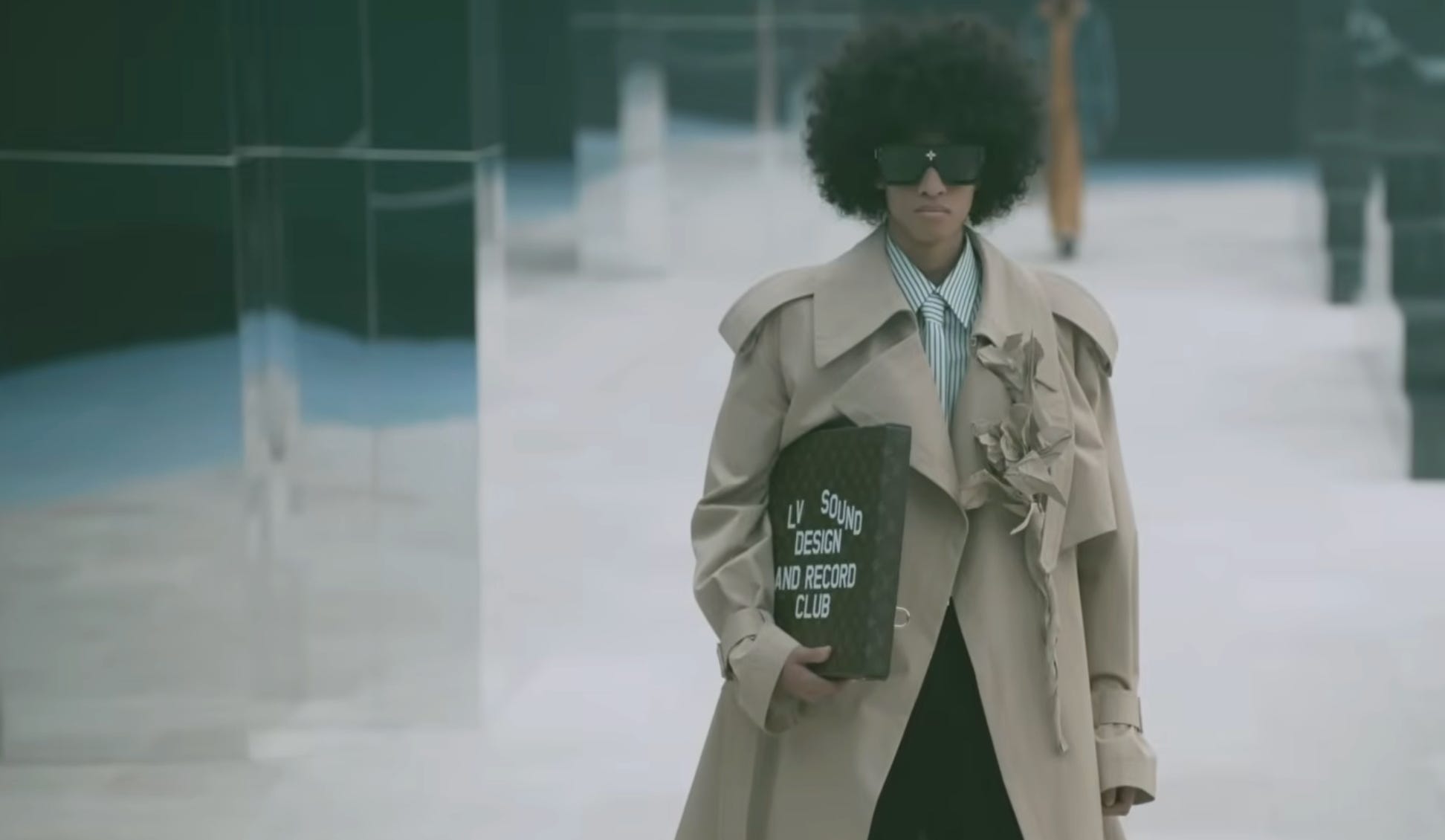
Virgil Abloh designed his career with legacy in mind, moving between architecture and music. In the film, there’s a scene in which a character carries a record box under their arm. I read it as Abloh passing the baton.
Synthetic Response